Scene immersion – watch your story unfold
One of my favourite parts of the writing process is scene immersion, taking myself into the scene as a silent observer. By that I mean using my imagination to place myself into the action alongside the other characters.
Take this excerpt from the second chapter in Transformation – Book 3 in the Moreton Scientific Investigation series:
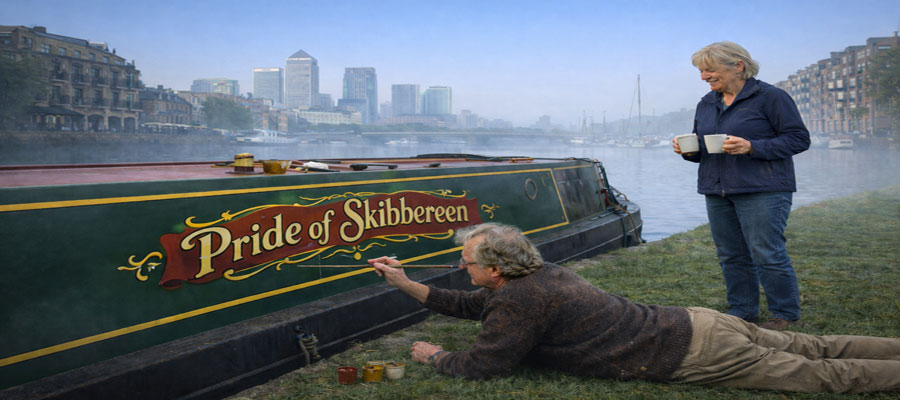
Mary O’Hare carried the steaming mug of tea along the towpath, placing it next to her husband, who sprawled on his belly, squinting through the one lens left in his glasses.
“What do you think?” he said, kneeling so she could have a clear view.
“Pretty good,” she said.
“Just pretty good?” he said, standing and taking a mouthful of tea.
“The gold. It doesn’t look right. It’s too yellowy.”
“Can’t do much about that, Mary. They didn’t have gold paint.”
“You should have waited, Connor. It’s a great bit of painting, but yellow doesn’t look classy like gold, and the name of the boat is the first thing people look at.”
Connor O’Hare smiled and agreed with his wife as usual, but he felt more than satisfied with the new name of the sixty-foot narrowboat, the ’Pride of Skibbereen,’ which proudly adorned the emerald-green hull in red and yellow ornate lettering, concealing the original name given when it was constructed fifty years before.
“Have you finished all the paperwork yet?” she said, passing him a chocolate biscuit.
“Paperwork?”
“Don’t bullshit me, Connor O’Hare. You know exactly what paperwork I’m talking about. For the boat’s name change.”
He sighed and smiled again. She was like a dog after a bone.
“I’ve let the insurers know, but I haven’t told the Canal and River Trust yet. I’ll do it later. Let’s just enjoy the new name for now and let the paint dry.”
Standing as far back as he could to look at the fresh paint, Connor admired the professional finish to the lettering. Not a bad effort at all for someone who was not a signwriter. He cupped the mug in his hands to warm stiff fingers, stiff from being locked onto a brush and holding a Mahl stick for hours to steady the brush.
I lived in Leicestershire, many moons ago, I used to go fishing on the Grand Union Canal very early in the morning. Mist would hover on the water. Canal barges were moored along the tow path in long rows, with the sun breaking through. Moorhens and ducks went about their business, all forming a kaleidoscope of colourful atmospheric magic. A sheer joy to sit there as a kid watching the peace and tranquility of the water coming to life. I recall this so vividly it was a great setting for the start of the book. On one fishing trip I watched a canal barge owner touching up the paintwork, going over the name of the boat with a steady hand. While he painted I hooked the largest fish I had ever caught in the canal and that memory has stuck with me for over five decades.

When I began writing the chapter I simply dropped myself back into that childhood scene. I imagined a retired couple with the husband painting a new name on the side of their boat. In my mind I stood on the tow path watching and let the projector of my imagination fill the screen. I decided to make them southern Irish as I went on holiday there a few years back to Skibbereen. It’s a pretty coastal town south of Cork and I loved the locals unique, quirky sense of humour and beautiful accent.
With the the seed of an idea in place I shut my eyes and had a grand stand view as they acted out the scene. I tried out and discarding many strands of conversation, listening to their voices in my head. I got used to the way they interacted, argued, laughed, and enjoyed their new holiday home. When I had that firmly fixed I could envisage the rest of the physical scene around them. This may sound the ravings of a madman but it works perfectly for me – but did take some practice.
I also needed to have close proximity to the River Thames as the story starts in central London. After some research I returned to the chapter and used Limehouse Basin. This wide basin with loch gates at either end links The Regents Canal to the Thames. This served the plot perfectly.

I have heard some authors say they don’t have a vivid enough imagination to do this. I would counter that. Practicing scene immersion not only helps the writing process but is such a joy when you are there. Hanging out with your cast of imaginary friends, sparks realistic conversation and new ideas. Try it on a short story and put yourself in each scene,, watching, listening and grow the story. You can take yourself wherever you want on the planet… and in my case a lot further than planet Earth!